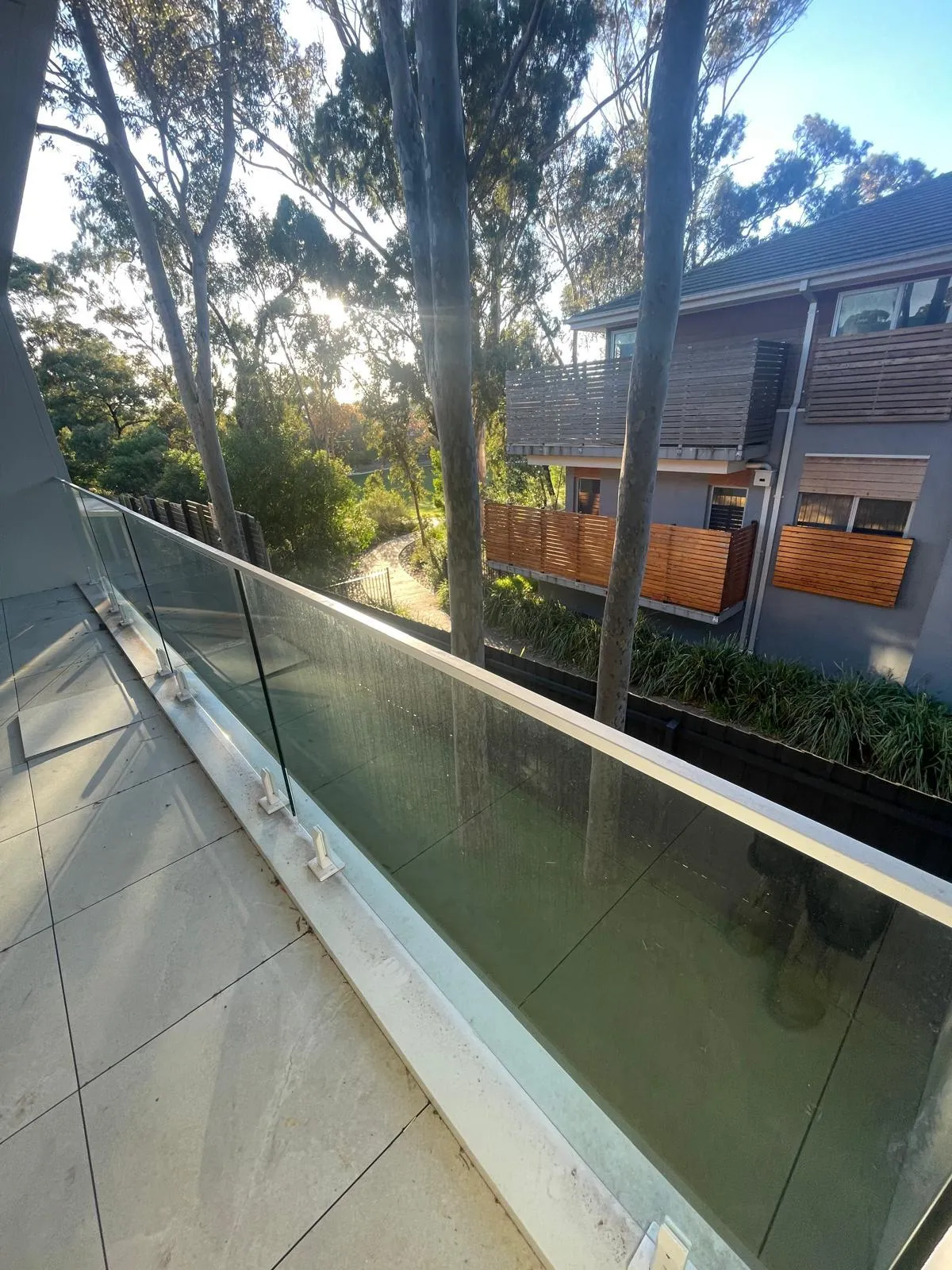
A glass balustrade is a piece of structural glass holding a person back from a fall. It is regulated to AS 1288:2021, which sets out glass thickness, fixing type, and the loads the assembly has to survive. Done well, a frameless balustrade will outlast the surrounding building. Done badly, it can fail in any number of quiet ways — none of them visible until the day they matter.
The most common failure is at the spigot. The spigot is the structural fixing at the base of each glass panel — a small post bolted through the slab or the timber bearer, with the glass clamped into a slot at the top. AS 1288 allows several spigot patterns, but the ones we see fail are almost always the cheap ones. Mild-steel spigots powder-coated to look like stainless will rust from the inside out within a few years of installation. By the time the rust is visible at the seam, the bolt-down is already compromised.
We specify 316 marine-grade stainless on every spigot, every project. The price difference between 316 and the cheaper options is real but small — perhaps fifteen per cent of the spigot line — and the failure mode is bad enough that we do not negotiate it. Coastal projects also get a marine wash schedule built into the aftercare pack.
The second failure is glass deflection. AS 1288 sets a deflection limit at the top of the glass under load. If the spigot pattern is too sparse, or the glass is too thin, the panel will sway visibly when leant on. That sway is not just a feel issue — it tells you the assembly is at the edge of its load envelope, and small impacts that should be absorbed are being transferred to the spigot bolts and the substrate.
The fix is thickness and pattern. Twelve-millimetre toughened on appropriate spigot centres is the residential standard. On longer runs we will move to fifteen-millimetre or to a top rail. Twelve-millimetre at the right pattern reads as rigid; the same glass at a stretched pattern will sway under the load AS 1288 allows. The standard is the floor, not the design.
The third failure is the gap between panels. Frameless balustrades cannot have gaps wider than 100mm at any point — both for AS 1288 and for the pool-fencing standard if the balustrade adjoins a pool zone. The gap can creep over time as the spigot bolts settle, as the slab moves with seasonal expansion, or as the building itself settles in its first few years. We check the gap on every install at handover, again at the six-month aftercare, and any panel that has moved outside spec is re-set.
The fourth is the substrate. A balustrade is only as strong as what it bolts into. We will not install a frameless balustrade onto an unrated timber bearer, a tile-over-deck that has not been confirmed for structural fixing, or a substrate the original engineer did not specify for it. On retrofits we ask for the engineering or, if there is none, we engage a structural engineer before quoting. This is the line that separates a glazier from a glass salesman — we will lose the job rather than install onto an unknown substrate.
The fifth, less obvious, is hardware corrosion on the glass-clamp design. Some channel-fixed balustrades rely on a clamp screw that runs through the glass panel. If the screw is mild steel and the moisture penetrates the hardware, the screw fails before the glass does — and the panel becomes loose. We use only sealed-clamp marine hardware on glass-clamp fixings, with replaceable stainless components.
None of these failure modes is exotic. They are all known and documented. The reason they appear so often on residential balustrades is that the cost difference between the right specification and the wrong one is small, and the failure is years away — long enough for the installer to be hard to chase, and short enough for the homeowner to wonder where the warranty went.
Our specification on every balustrade names the spigot brand and grade, the glass thickness and toughening certification, the bolt-down detail and the substrate confirmation. The aftercare schedule pulls the assembly back in at six, twelve and twenty-four months. None of that is heroic. It is just the discipline the work demands.
Written by Jason Ah-Young, Director of Maison Glass & Aluminium. For advice on a specific project, book a consultation.